A shoe by the bed, a leather glove, a collar, a strip of latex under club light. Some objects are never only objects — fetish culture begins where erotic life refuses to stay inside the body.
Some objects are never only objects.
A shoe left beside the bed. A leather glove. A silk stocking. A collar, a mask, a strip of latex gleaming under club light. These things are not alive, and yet in fetish culture they appear almost animate. They summon attention. They change posture. They ask to be touched. They make the body arrive differently.
The mistake is to ask, too quickly, what the object "stands for." A boot must stand for domination. A stocking must stand for femininity. Latex must stand for artificial skin. Leather must stand for masculinity, danger, animal hide, biker culture, queer nightlife. All of this may be true. But the object does not only stand for something. It does something. It presses, shines, smells, constrains, frames, conceals, reveals. It gives desire a surface.
Fetish culture begins from a fact both obvious and strange: erotic life does not stay inside the body. It leaks outward. It attaches itself to fabrics, rooms, gestures, tools, rituals, and signs. A thing becomes sexy not because it stops being material, but because its materiality becomes charged. The object becomes a site where memory, arousal, fantasy, touch, taboo, and social meaning gather.
Sexology has often tried to discipline this mystery by naming it. In clinical language, "fetishism" has usually meant recurrent sexual arousal involving nonliving objects or highly specific body parts. But contemporary diagnostic thinking makes an important distinction: a fetish interest is not automatically a disorder. Martin Kafka's review of the DSM criteria for fetishism emphasizes that the clinical question is not simply whether someone is aroused by an object, but whether the pattern causes distress, impairment, compulsion, or harm. The fetish itself is not the pathology. Desire becomes a clinical concern when it injures life, consent, or functioning.
This distinction matters because fetish culture has long been forced to live under the suspicious gaze of medicine. A. De Block and P. R. Adriaens, in their history of the pathologizing of sexual deviance, show that categories like "perversion," "paraphilia," and "disorder" are historically unstable. They do not descend from nature untouched. They are shaped by psychiatry, law, morality, religion, and cultural anxiety. One century's symptom may become another century's subculture. One era's deviance may become another's aesthetic.
So the better question is not: why are some people aroused by strange objects? The better question is: why did we ever imagine erotic life would restrict itself to flesh?
The evidence suggests that fetish objects are rarely random. In one of the most useful empirical studies of fetish categories, Claudia Scorolli and colleagues examined hundreds of online fetish discussion groups and estimated the relative frequency of different fetish interests. Their findings are revealing. The most common targets were body parts or body features, followed closely by objects associated with the body. Feet and objects associated with feet were especially common. Objects entirely unrelated to the body were much less frequent.
This tells us something profound and simple: the fetish object usually lives near the body before it becomes a substitute for it. Shoes, stockings, gloves, underwear, leather harnesses, latex suits, collars, uniforms—these are not arbitrary things. They touch the body, frame it, smell of it, hide it, protect it, discipline it, or alter how it moves. They are body-adjacent. They carry the body's outline after the body has gone.
A shoe is a foot's architecture. A glove is a hand without the hand. A corset is breath made visible. Latex is not merely a material; it is a second skin with better lighting.
This is one reason fetish objects often feel haunted. They are relics of contact. They belong to the erotic category of the trace: the thing that proves the body was here. In this sense, fetishism is not so different from ordinary longing. Lovers keep shirts. Children keep blankets. Pilgrims kiss icons. Museums preserve fragments of the dead. Human beings have always allowed matter to carry presence.
But erotic objects do not only remember the body. They can train the body.
Research on sexual conditioning suggests that arousal can attach itself to cues. James Pfaus, Tod Kippin, and Soraya Centeno's review of conditioning and sexual behavior gathers evidence that sexual reward can shape responses to smells, places, signals, partners, and environments. William O'Donohue and Joseph Plaud's work on human sexual arousal also argues that sexual response can be conditioned, though never in the simple mechanical way that popular accounts sometimes suggest. Human beings are not laboratory bells waiting to be rung. Fantasy, shame, attention, memory, interpretation, and culture all intervene.
Still, the basic principle is persuasive: if a texture, garment, image, smell, or object is repeatedly present at moments of arousal, secrecy, intensity, orgasm, fear, safety, humiliation, worship, or first discovery, it may become more than background. It may become a cue. It may begin to glow.
This does not mean that every fetish has a single origin story. The common fantasy of explanation—"this happened once in childhood, therefore the fetish"—is usually too neat. Desire is rarely a detective novel with one clue and one culprit. It is more like sediment. Experiences accumulate. A material appears. A scene repeats. A taboo intensifies it. A fantasy protects it. A community gives it language. Eventually the object no longer needs to explain itself. It has become erotic fact.
But if conditioning helps explain how an object acquires charge, it does not explain why some objects are so especially available to erotic charge. For that, we have to return to sensation.
The fetish object is often a technology of touch.
Leather smells. Latex shines. Rubber resists. Silk slides. Fur warms. Metal chills. Rope burns slightly, then holds. High heels alter the ankle, pelvis, gait, and height. A mask changes the face into an emblem. A hood changes breathing and identity. A collar turns the neck into a sentence. A glove makes the hand both more formal and less naked.
These materials are not passive props. They produce sensations and postures. They choreograph the body. They make certain fantasies easier to inhabit because they give them physical form.
A study by Ryo Kitada and colleagues on tactile pleasantness is not about fetishism directly, but it helps explain why objects can feel erotically compelling. The researchers found that tactile pleasantness peaked when object softness approximated the compliance of human body parts. In other words, some objects please the hand because they echo the body. They are not bodies, but they rhyme with bodies.
Fetish materials often work through this kind of sensory rhyme. Latex can look like skin, but impossibly smooth, sealed, reflective, perfected. Leather can feel like skin's tougher cousin: animal, protective, worn, creased, warm after contact. Silk is not flesh, but it teaches the skin to notice itself. Rope is not an embrace, but it can imitate the seriousness of one.
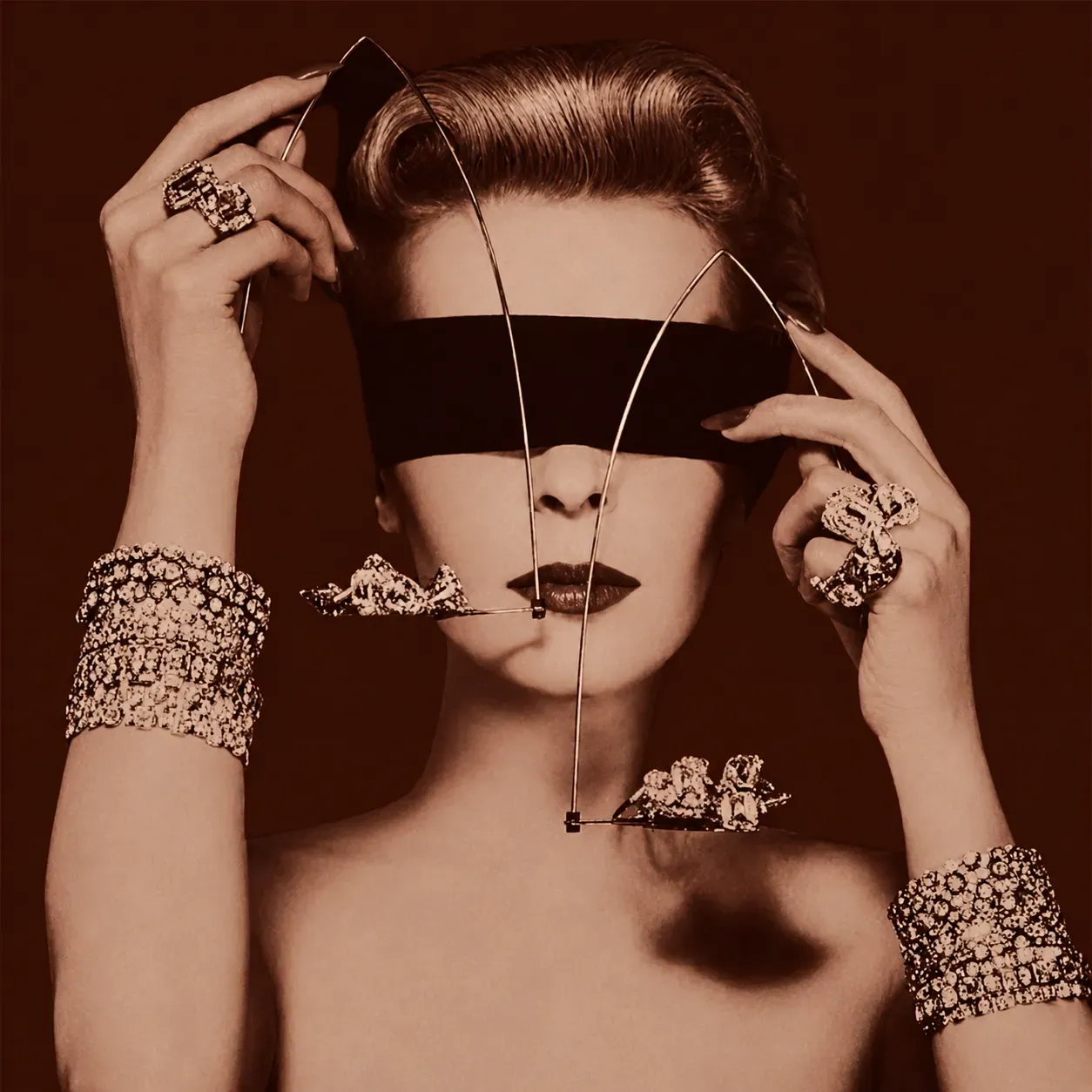
Still, no object enters desire naked of culture. A leather jacket in one room is fashion; in another, armor; in another, queer inheritance; in another, threat; in another, invitation. Fetish culture is not just a collection of private arousals. It is a system of reading.
The classic sociological paper by Martin Weinberg, Colin Williams, and Charles Moser, "The Social Constituents of Sadomasochism," remains useful because it treats BDSM not as individual abnormality but as a social world. Kink has norms, scripts, roles, rituals, safety practices, jokes, status markers, and forms of apprenticeship. A collar does not mean the same thing everywhere. A whip does not speak by itself. A boot becomes legible because a culture teaches people how to see it.
This is where fetish becomes aesthetic. The object is erotic because it condenses a scene. A uniform may gather discipline, anonymity, hierarchy, parody, class, gender, danger, and theatrical authority. A collar may gather surrender, ownership, trust, adornment, animality, and chosen vulnerability. A mask may gather shame, freedom, depersonalization, glamour, and escape.
The object becomes a shorthand for an entire erotic grammar.
This helps explain why fetish culture is so visual, even when its pleasures are tactile. It cares about shine, cut, silhouette, polish, fastening, posture, display. Fetish wear does not merely reveal the body. It edits the body. It turns the body into a more deliberate version of itself. It says: this body has entered a scene.
The mainstream often misunderstands this as superficiality, as if clothing and objects were merely decorative additions to sex. But fetish culture understands something older and deeper: costume is not the opposite of truth. Sometimes costume permits truth. A person may feel more naked in a mask than without one. A collar may reveal a desire that ordinary speech cannot safely carry. A latex suit may not hide the body so much as translate it.
Fetish is often accused of replacing the person with the thing. That can happen. Desire can become narrow, compulsive, or avoidant. But the richer truth is that fetish often reveals how much personhood already depends on things. We meet one another through objects constantly: clothes, beds, perfumes, phones, cars, jewelry, doorways, dinner tables, letters, photographs. Human intimacy has always been mediated.
The fetish object simply refuses to pretend otherwise.
There is, however, a difference between fetishism and objectum sexuality, where the object is not only an aid to desire but the beloved itself. Julia Simner, James Hughes, and Noam Sagiv's study of objectum sexuality offers one of the first empirical accounts of people who experience romantic, emotional, and/or sexual attraction to specific inanimate objects. Their research found links between objectum sexuality, autism, and synaesthesia, suggesting that for some people, object attraction may involve distinctive perceptual and emotional relations to the material world.
This complicates any simple hierarchy in which persons are real and objects are merely symbolic. For some, the bridge, wall, machine, statue, or instrument is not a metaphor. It is the site of attachment. Whether or not one understands that experience from the inside, it forces a philosophical question: how much of love is already projection, animation, attention, ritual, and the granting of inner life?
The fetish object lives near that question. It is matter treated as if it can answer.
Of course, fetish culture also lives near taboo. Its objects often borrow power from prohibition. A garment becomes charged because it should not be touched. A uniform becomes erotic because it belongs to authority. Underwear becomes erotic because it is hidden. A shoe becomes erotic because it is low, dirty, intimate, beneath. Leather and rubber can carry associations of danger, labor, queerness, nightlife, punishment, animality, and refusal. The forbidden does not create desire by itself, but it can sharpen it. It gives desire an edge.
This is why shame has such a complicated role in fetish life. Shame can wound, isolate, and pathologize. But the aesthetic of fetish often takes what was shameful and turns it into ceremony. The hidden object comes into the light. The private sign becomes a dress code. The embarrassing desire becomes a shared language. What was once "wrong" becomes crafted, negotiated, polished.
There is an ethics here, and it should not be romanticized away. Fetish culture at its best depends on consent, negotiation, care, and the difference between fantasy and harm. Objects can intensify power, but power must be held responsibly. A collar is not consent. A costume is not permission. A fantasy of coercion is not actual coercion. The fact that an object is erotic to one person does not make another person available through it.
The object may carry desire, but ethics belongs to people.
Still, there is something tender in the fetish object's seriousness. It says that desire is not abstract. It needs handles, textures, colors, weights. It needs little altars. It needs the smell of leather, the pull of laces, the cold clasp at the throat, the shine that turns a body into an icon of itself.
Modern life often treats objects as commodities: buy them, use them, discard them. Fetish culture treats objects as charged companions in psychic life. It knows that matter can become intimate. It knows that a thing can be touched so intensely by fantasy that it begins to touch back.
Perhaps that is what makes an object sexy: not that it replaces the body, but that it teaches the body how to want. It concentrates longing. It gives imagination a surface. It turns memory into texture and taboo into form. It allows desire to leave the body and return wearing something beautiful, severe, ridiculous, sacred, or obscene.
A fetish object is sex made portable. Sex made symbolic. Sex made touchable.
It is the ordinary world, suddenly unable to remain neutral.
Kafka, Martin P. "The DSM Diagnostic Criteria for Fetishism." Archives of Sexual Behavior 39, no. 2 (2010): 357-362. https://doi.org/10.1007/s10508-009-9558-7
De Block, Andreas, and Pieter R. Adriaens. "Pathologizing Sexual Deviance: A History." Journal of Sex Research 50, no. 3-4 (2013): 276-298. https://doi.org/10.1080/00224499.2012.738259
Scorolli, Claudia, Stefano Ghirlanda, Magnus Enquist, Simone Zattoni, and Emmanuele A. Jannini. "Relative Prevalence of Different Fetishes." International Journal of Impotence Research 19 (2007): 432-437. https://doi.org/10.1038/sj.ijir.3901547
Joyal, Christian C., and Julie Carpentier. "The Prevalence of Paraphilic Interests and Behaviors in the General Population: A Provincial Survey." Journal of Sex Research 54, no. 2 (2017): 161-171. https://doi.org/10.1080/00224499.2016.1139034
Pfaus, James G., Tod E. Kippin, and Soraya Centeno. "Conditioning and Sexual Behavior: A Review." Hormones and Behavior 40, no. 2 (2001): 291-321. https://doi.org/10.1006/hbeh.2001.1686
O'Donohue, William, and Joseph J. Plaud. "The Conditioning of Human Sexual Arousal." Archives of Sexual Behavior 23 (1994): 321-344. https://doi.org/10.1007/BF01541567
Letourneau, Elizabeth J., and William O'Donohue. "Classical Conditioning of Female Sexual Arousal." Archives of Sexual Behavior 26 (1997): 63-78. https://doi.org/10.1023/A:1024573420228
Weinberg, Martin S., Colin J. Williams, and Charles Moser. "The Social Constituents of Sadomasochism." Social Problems 31, no. 4 (1984): 379-389. https://doi.org/10.1525/sp.1984.31.4.03a00020
Holvoet, Lien, Wim Huys, Violette Coppens, Jantien Seeuws, Kris Goethals, and Manuel Morrens. "Fifty Shades of Belgian Gray: The Prevalence of BDSM-Related Fantasies and Activities in the General Population." Journal of Sexual Medicine 14, no. 9 (2017): 1152-1159. https://doi.org/10.1016/j.jsxm.2017.07.003
Simner, Julia, James E. A. Hughes, and Noam Sagiv. "Objectum Sexuality: A Sexual Orientation Linked with Autism and Synaesthesia." Scientific Reports 9 (2019): 19874. https://doi.org/10.1038/s41598-019-56449-0
Kitada, Ryo, Megan Ng, Zheng Yee Tan, Xue Er Lee, and Takanori Kochiyama. "Physical Correlates of Human-Like Softness Elicit High Tactile Pleasantness." Scientific Reports 11 (2021): 16510. https://doi.org/10.1038/s41598-021-96044-w
The Scarlet Salon is a curated dinner society. Every guest completes the Matchmaker quiz and submits identity verification. Apply for a seat